"
Archeologists have discovered the Jupiter lighthouse, which was thought to be
located on a natural hill, is actually located on an ancient Indian mound "
 |
Jupiter
Inlet Lighthouse was completed and first illuminated on July 10,1860.
The final cost of $60,859.98 was nearly twice the amount of the
original congressional allocation.
|
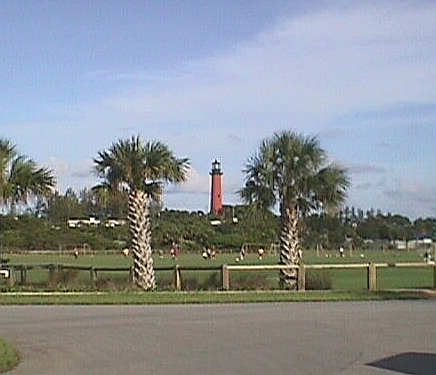
Located next to a
really nice athletic field and situated on a hill overlooking the
inlet, this superbly resorted lighthouse is very easy to find.
|
The Florida Lighthouse Board in 1852 recommended that a lighthouse be built
near Jupiter Inlet to make the lower coast safer for ships and help mariners
avoid the dangerous shoal offshore where the Loxahatchee River flows to the
Atlantic Ocean.
In 1853 the lighthouse site chosen was part of the Fort Jupiter reservation
established during the First Seminole War in 1836. George G. Meade, the Union
general who defeated General Robert E. Lee at the Battle of Gettysburg, designed
the tower.
The main difficulty in building the lighthouse was the shutting of the inlet
by silt in 1854, which forced workers to send 500 tons of construction materials
down the Indian River in shallow boats. The Third Seminole War suspended work at
the site from 1856 to 1858 and resulted in constructing the keeper's house of
thick coquina walls and an inside well so keeper's could withstand an Indian
siege. Heat, insects, and moisture hampered the construction of the lighthouse.
In 1860, after an expense of more than $60,000 for supplies and labor, the lamp
was lit just before the Civil War.
The U.S. government established a life-saving station near the lighthouse in
1886 to rescue people in distress at sea.
The conical tower was left a natural brick color for the first 50 years, but
dampness discolored the brick to such an extent that it was painted red around
1910.
In 1928 engineers substituted electricity for the old mineral oil lamps and
cumbersome weights and installed a diesel generator in case of power failure. In
the same year a hurricane struck the tower, smashed one of the bull's-eyes, and
disabled the emergency diesel generator. The keeper had to reinstall the old
mineral lamps and turn the light by hand. During the hurricane, the tower swayed
17 inches from the vertical. The damaged bull's-eye was sent to Charleston to be
reassembled and held together with a band of brass.
The 105' red tower stands 146' above sea level, has a light that can be seen
25 miles at sea, and has walls that taper from 31" thick at the base to
18" near the top.
The lighthouse is open to visitors on
Sunday Afternoons
A lighthouse to mark a dangerous shoal off
"Point" Jupiter was proposed as early as 1851. Congress acted quickly
and $35,000 was appropriated in 1853. Work on the lighthouse was hampered by the
periodic closure of Jupiter Inlet. With the inlet closed, building supplies were
brought in through the Indian River Inlet (which is now closed) nearly 35 miles
north of the lighthouse site. The supplies were ferried down the shallow river
in small boats.
Mosquitoes, sandflies, sickness and the threat of Indian attacks stopped work
on the lighthouse several times. Finally, the lighthouse was completed and first
lit on July 10, 1860. Built at a cost of $60,859.50, the 115 foot tall brick
tower contained a fixed white light varied by a brighter white flash every 90
seconds. The light was produced by a state-of-the-art first order Fresnel lens
made by the Henry Lepante Company of Paris.
The light didn't shine for very long. The assistant keeper participated in a
successful plot to capture the lighthouse from its Union sympathizing head
keeper. Important parts of the lens were removed from the tower and hidden for
the duration of the war. After the war was over, the parts were recovered and
the light relit on June 28, 1866.
A second keeper's dwelling was built at the station in 1883. The keepers were
relieved of rescue duties three years later when a life saving station was built
on the south side of the inlet. A telegraph signal station was added to the
lighthouse station in 1898. The original keeper's dwelling burned down in 1927.
The light station was electrified in 1928 and damaged by a hurricane later the
same year. The storm knocked out the electrical plant, forcing the keeper's son
to turn the lens by hand and use the old style old lamps to keep the light going
through the storm. During the storm, the top of the tower was reported to have
swayed up to 17 inches. Several window panes were broken at the top of the
tower, and one of the bulls-eyes section of the lens was shattered.
In 1973, Jupiter Inlet Lighthouse was put on the National Register of
Historic Places. For a number of years Jupiter Inlet Lighthouse sported a
"firehouse" red coat of paint, but in 1999 a major restoration project
was started. The Coast Guard announced that the first order Fresnel lens at
Jupiter Inlet would be temporarily deactivated while a major renovation project
on the lighthouse occurs starting around September 1, 1999. During renovation,
the tower displayed a flashing white light (two flashes every 20 seconds) from a
modern optic instead of its regular characteristic of two flashes every 30
seconds. As part of the restoration work, the lighthouse's walls will be
returned to their historic natural red brick color instead of the painted on
fire engine red color that it has showed in recent years. The work on the tower
was expected to take about 8 months, and cost about $800,000. The tower was
closed to tours during the renovation work.
During the work, archeologists have discovered the Jupiter lighthouse, which
was thought to be located on a natural hill, is actually located on an ancient
Indian mound. Archeologists dug several 3'X3' holes around the base of the
lighthouse and have found shells and pottery fragments. Preliminary estimates
have put the origin of the hill to around 700 AD.
Several different colors of red brick were used in the lighthouse's
construction, so it was eventually decided to paint the lighthouse but to use a
more natural brick color. In late April 2000, the town of Jupiter held a
relighting ceremony that was attended by thousands.
Jupiter Inlet Lighthouse is administered by the Florida
History Center & Museum, who also administer the DuBois Home. The lighthouse
is owned and maintained as an active maritime aid to navigation by the U.S.
Coast Guard.
The Jupiter Inlet Lighthouse is Palm Beach County's oldest structure and is
listed on the National Register of Historic Places. The Lighthouse is maintained
by Florida History Center & Museum in cooperation with The United States
Coast Guard.
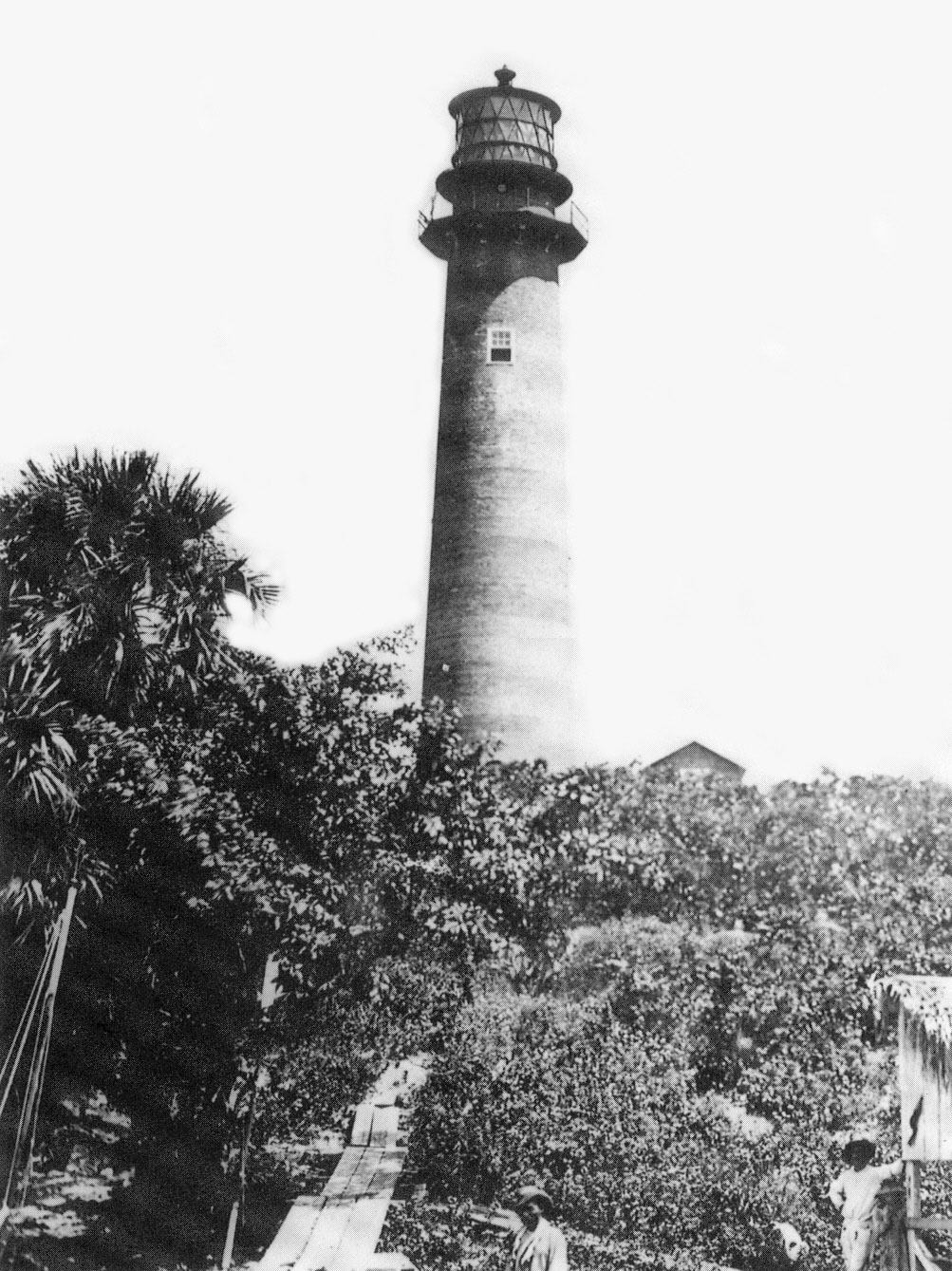
Jupiter Inlet
Lighthouse 1883
| JUPITER
INLET LIGHTHOUSE TIMELINE
1853
Under the administration of President Franklin Pierce,
$35,000 was appropriated for the building of a lighthouse at Jupiter
Inlet. Designer Lt.George Gordon Meade, later gained fame as the
general in command of the victorious Union forces at the battle
of Gettysburg.
1854
The Jupiter Inlet silted over and 500 tons of construction materials
for the Lighthouse had to be taken up to the Indian River Inlet. The
Lighthouse lenses, designed by Augustin Jean Fresnel, a French
physicist, were shipped from France.
1856
Construction halted due to attacks by Seminole Indians.
1859
Work on the Lighthouse stopped a second time because the workers were
ill from "Jupiter Fever."
1860
Jupiter Inlet Lighthouse was completed and first illuminated on July
10,1860. The final cost of $60,859.98 was nearly twice the amount of
the original congressional allocation.
1861
The light was darkened when two of the assistant keepers removed part
of the lens. The keepers were trying to aid Confederate ships trying
to break through the Union's blockade of the Jupiter Inlet. The light
was illuminated again after the Civil War - June 28, 1866.
1866
Captain James Armour was appointed as assistant keeper and assumed the
responsibilities of head keeper two years later Capt. Armour held the
position for over 40 years.
1928
The Lighthouse was converted from oil lamps to electricity with a
diesel motor with a diesel generator for back-up. Local history has it
that the electricity failed during the 1928 hurricane. World War II:
The United States Coast Guard assumed responsibility for the Jupiter
Inlet Lighthouse in 1939. The Jupiter Inlet silted closed in the
winter of 1942 and remained closed for the duration of the War. Coast
Guard personnel maintained surveillance, from the top of the tower,
for enemy submarines. Despite their best efforts, several ships were
torpedoed just off the Inlet with terrible loss of life.
1999
The Jupiter Inlet Lighthouse is reserved and interpreted to the
general public by Florida History Center & Museum. The beacon is
maintained by the United States Coast Guard and continues to be a
critical aid-to-navigation. The Lighthouse is of the "first
order" meaning that it is one of the tallest and most powerful
lighthouses in the country. |
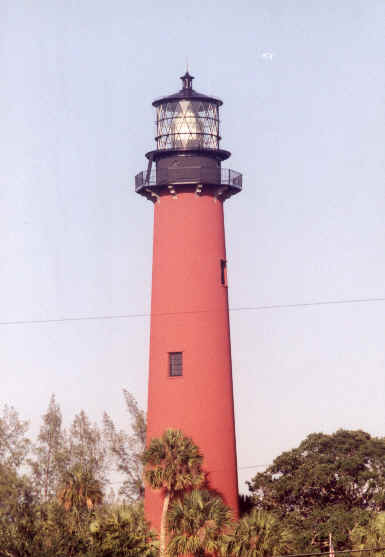
-
Park
at the parking lot next to the athletic field and take a 5 minute
walk to see this really nice lighthouse close up.
-
|
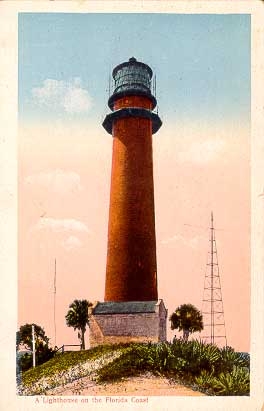
| Old postcard
showing the Jupiter Wireless station
|
Sidebar
– The Jupiter Wireless Station
This postcard of the Jupiter Lighthouse
shows in good detail the Jupiter Wireless Telegraph Station antenna
masts. The mast to the left of the lighthouse was the main and
original mast structure and was connected to the lattice tower seen to
the right of the lighthouse.
The original construction date of the
Wireless Station is uncertain but is believed to be sometime after
1900. The U.S. Navy
constructed the first wireless telegraph experimental facility in
Arlington VA. The second
wireless Telegraph facility was constructed in Jupiter.
"The Jupiter site was chosen
mainly because of its location. It
was 1000 miles from Arlington, just far enough to make experimentation
with wireless quite realistic and useful.
It was linked with other wireless sites by landline telegraph
and it was far enough south for ship-to-shore testing and the Gulf at
the Caribbean waters." Additionally,
the southernmost U.S. weather service station was located in Jupiter
at the site.
"In the early days, the Jupiter
facilities consisted principally of the main building, a power
building, a storage house, a boathouse with dock, quarters for the
petty officer in charge at a 120-foot wooden antenna mast." The
entire facility occupied about three acres of the government
reservation property.
"The antenna mast was made in the
style of the early sailing ships, several long wooden poles lashed
together with steel wire ropes. This mast was kept upright by a
multitude of guy wires and stood magnificently on the north side of
the Jupiter River for a good many years."
The primary mission of the wireless
station was to provide aid to mariners
Part of the mission of serving maritime
operations was to issue time checks for passing ships. Time checks
were important because it helped the ship establish its exact
location. The Jupiter wireless station would transmit its time check
at 12:05 each day (Five minutes after the signal was broadcast from
Arlington). Additionally, the Jupiter station gave a visual time check
to passing ships by dropping a time ball. A five-foot diameter canvas
ball was hoisted 100 feet up the antenna mast at 11:55 a.m. each day.
At noon when the time-click from Arlington was received, the time ball
was dropped down the mast. In this manner mariners were able to
accurately fix their location, time, and distance to port.
Also, because Jupiter operated a
telegraph station at the same facility, mariners could have messages
telegraphed by land line to their destination ports.
A
second operational mission was to provide for testing and evaluation
of wireless facilities for the government. In this respect the
wireless station served well acting as a test site for government
transmissions and assisting in the development of wireless technology
throughout the world.
|
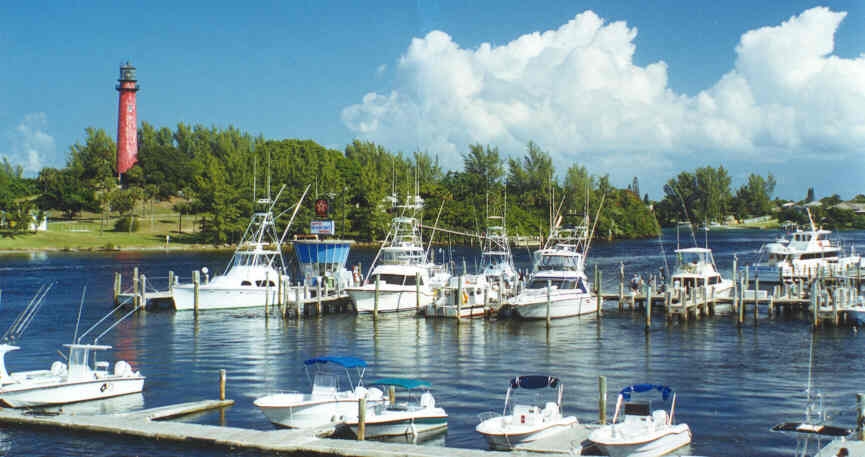
Jupiter
Inlet Lighthouse
For More Information please call
(561) 747-8380/6639